EN 12464-1:2021 lighting levels: the lux, glare and uniformity values for offices, shops, hotels and corridors
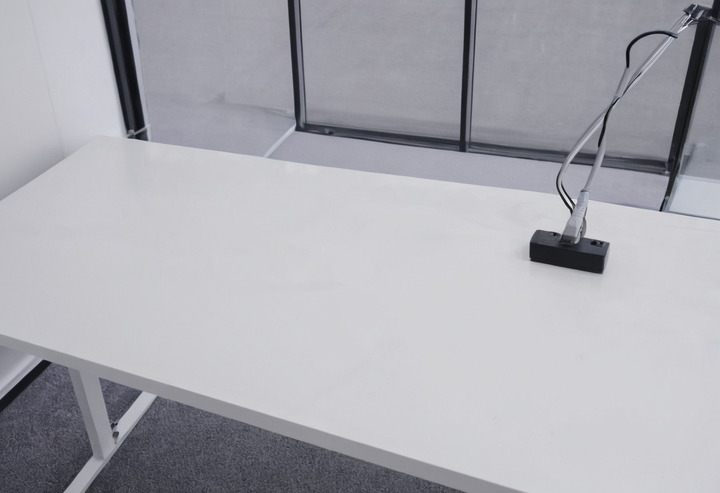
EN 12464-1:2021 is the European standard for lighting indoor work places. The standard gives every task area a maintained illuminance in lux, a glare limit (UGR), a uniformity ratio (Uo) and a colour rendering minimum (Ra), and the 2021 edition adds context modifiers that raise the office figure from 500 lx to 750 lx or 1000 lx.
What EN 12464-1:2021 requires for every indoor task area
EN 12464-1:2021 requires four values for every indoor task area: a maintained illuminance Em in lux, an upper glare limit UGRL, a minimum uniformity Uo and a minimum colour rendering index Ra, and the 2021 edition adds wall, ceiling and cylindrical illuminance values to the task-area figures. The standard covers indoor work places; the companion standard EN 12464-2:2014 covers outdoor work places, as the lighting manufacturer Techlumen states in its EN 12464 specification guide.
The maintained illuminance Em is the value below which the average illuminance on the reference surface must not fall over the life of the installation, so a designer adds a maintenance factor and installs more light on day one. The reference surface for office tasks is the desk plane at 0.75 m above the floor; for corridors, stairs and stores the reference surface is the floor.
The uniformity Uo is the ratio of minimum to average illuminance on the task area. EN 12464-1:2021 sets Uo at 0.60 for desk work and 0.40 for most circulation and general areas. The unified glare rating UGR runs from 10 (no perceptible glare) to 28 (severe glare), and the standard sets a ceiling of 19 for screen-based office work.
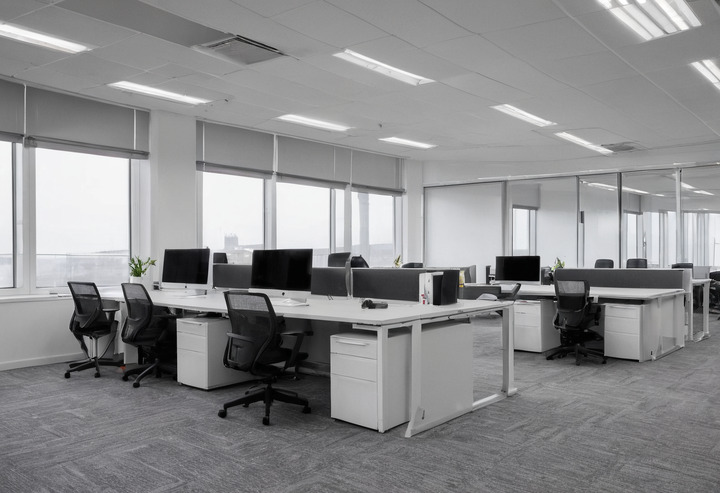
EN 12464-1 office lighting table: 300 lx to 750 lx by activity
EN 12464-1:2021 table 5.2 sets 500 lx, UGR 19, Uo 0.60 and Ra 80 for writing, reading and data processing, 300 lx and Uo 0.40 for filing and copying, 500 lx for CAD workstations and meeting rooms, 300 lx at a reception desk and 200 lx in archives, all measured on the 0.75 m desk plane. The DIALux knowledge base lists the same office values and adds 750 lx with UGR 16 for technical drawing.
| Office activity (table 5.2) | Em (lx) | UGRL | Uo | Ra |
|---|---|---|---|---|
| Filing, copying, circulation | 300 | 19 | 0.40 | 80 |
| Writing, reading, data processing | 500 | 19 | 0.60 | 80 |
| CAD workstations | 500 | 19 | 0.60 | 80 |
| Meeting and conference rooms | 500 | 19 | 0.60 | 80 |
| Reception desk | 300 | 22 | 0.40 | 80 |
| Archives | 200 | 25 | 0.40 | 80 |
| Technical drawing | 750 | 16 | 0.60 | 80 |
Two notes in the standard change how the office table is applied. Reception desks need 500 lx where staff read or write at the counter. Meeting rooms need dimmable lighting so that presentations and note-taking can each get the right level.
Screen work adds a luminance limit. Luminaires that can appear as reflections in a display screen must not exceed 1500 cd/m2 in the reflected direction, and luminaires rated UGR 19 or lower must also be checked for luminance at viewing angles of 65 degrees and above, according to the Techlumen guide.
The 2021 context modifiers raise 500 lx to 750 lx or 1000 lx
EN 12464-1:2021 introduced context modifiers, a list of conditions under which the tabulated illuminance must be raised: one or two applicable conditions raise the value one step, for example from 500 lx to 750 lx, and more than two conditions raise it two steps, to 1000 lx for office desk work. The conditions are listed by the lighting manufacturer ETAP in its summary of the 2021 changes.
The context modifiers named in EN 12464-1:2021 are:
- The visual work is critical.
- Errors are costly to rectify.
- Accuracy, higher productivity or increased concentration is important.
- Task details are of unusually small size or low contrast.
- The task is undertaken for an unusually long time.
- The task area has low daylight provision.
- The visual capacity of the worker is below normal, for example because of age.
The result is a three-step scale for a standard office. A young workforce doing routine screen work in a daylit room stays at 500 lx. A team doing long-duration detailed work in a room with little daylight moves to 750 lx. A team of older workers checking small, low-contrast detail for long periods with no daylight moves to 1000 lx. The lighting consultancy journal CIBSE Journal describes the same one-step and two-step rule and notes that the classroom base value also moved from 300 lx to 500 lx in the same revision.
Walls, ceilings and cylindrical illuminance: the room around the task
EN 12464-1:2021 sets illuminance on the room surfaces as well as on the task: the standard specifies 30 lx to 100 lx on ceilings and 50 lx to 150 lx on walls, with a cylindrical illuminance of 50 lx to 150 lx depending on the type of task and premises, according to the lighting manufacturer Fagerhult's summary of the standard. CIBSE Journal reports that the 2021 revision raised the wall figure to 75 lx to 150 lx and the ceiling figure to 50 lx to 100 lx for the spaces where people work for long periods.
Cylindrical illuminance is measured on a small vertical cylinder at 1.20 m above the floor for standing people and 0.85 m for seated people. For face recognition in spaces where people meet, EN 12464-1 asks for a minimum of 150 lx cylindrical illuminance with Uo of 0.10 or higher, per the Techlumen tables.
Fagerhult recommends going beyond the minimum in rooms where people spend the day: about 300 lx on the ceiling and 250 lx to 300 lx on the walls of a normal office or classroom, against the standard's floor of 30 lx and 50 lx. The difference between a room lit to the minimum and a room lit to that recommendation is the difference between a bright desk in a dim box and a room that reads as daylit.
Two further rules shape the layout. The border area around a task area is 15 percent of the smallest dimension of the area or 0.5 m, whichever is smaller, per ETAP. In transition zones, for example from a building entrance to an indoor corridor, the illuminance ratio between adjacent spaces should not exceed 1:5, per the Techlumen guide.
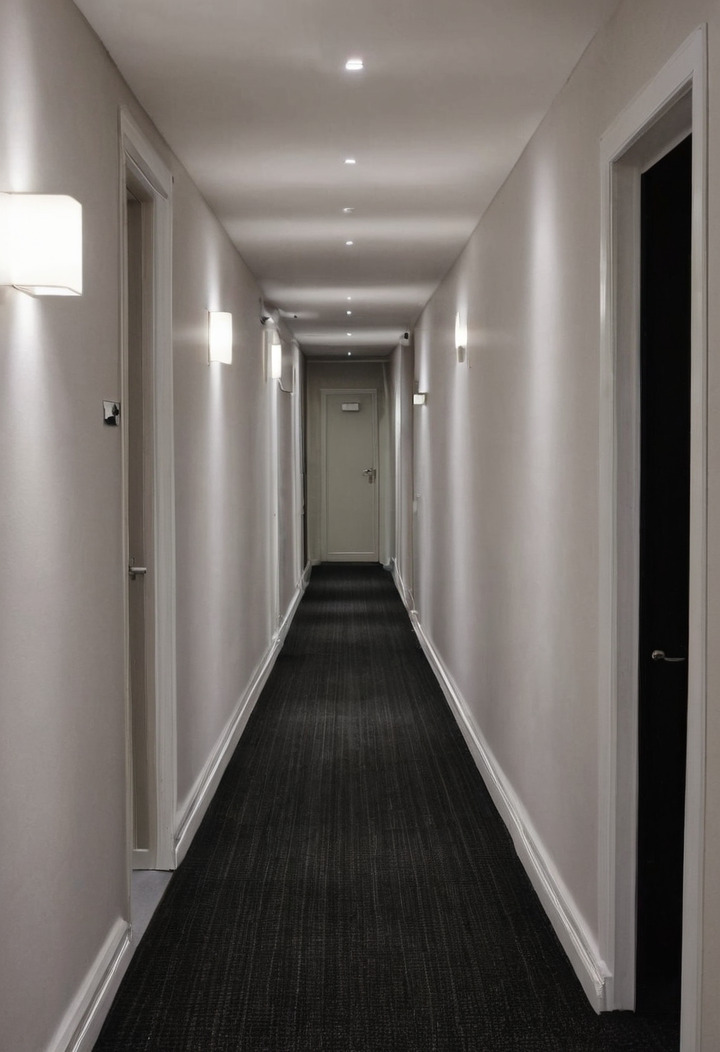
Lux values for shops, hotels, restaurants and circulation areas
EN 12464-1:2021 gives 300 lx for a general sales area (500 lx in a supermarket), 500 lx at checkouts, 200 lx in restaurant dining areas, 500 lx in a commercial kitchen, 100 lx for the general lighting of a hotel room and 100 lx at floor level in a circulation corridor, according to tables 5.1, 5.3 and 5.8 as reproduced by Techlumen.
| Area (EN 12464-1:2021 table) | Em (lx) | UGRL | Uo | Ra |
|---|---|---|---|---|
| Circulation corridors (5.1.1) | 100 | 28 | 0.40 | 40 |
| Stairs, escalators (5.1.2) | 150 | 25 | 0.40 | 40 |
| Sanitary facilities (5.1.7) | 200 | 25 | 0.40 | 80 |
| Sales area (5.3.1) | 300 | 22 | 0.40 | 80 |
| Checkout (5.3.2) | 500 | 19 | 0.60 | 80 |
| Waiting halls, foyers (5.4.1, 5.4.2) | 200 | 22 | 0.40 | 80 |
| Hotel reception, cashier (5.8.1) | 300 | 22 | 0.60 | 80 |
| Restaurant dining area (5.8.3) | 200 | 22 | 0.40 | 80 |
| Kitchen (5.8.5) | 500 | 22 | 0.60 | 80 |
| Hotel room, general (5.8.6) | 100 | 22 | 0.40 | 80 |
| Hotel room, writing and reading (5.8.7) | 300 | 19 | 0.40 | 80 |
| Hotel bathroom (5.8.8) | 200 | 22 | 0.40 | 80 |
| Conference and banquet hall (5.8.9) | 500 | 19 | 0.60 | 80 |
Three patterns run through the table. Ra 40 is accepted only in pure circulation spaces where colour does not matter; every space where people rest, wait, eat or wash requires Ra 80. Stairs get 150 lx against 100 lx for corridors because a missed step is a fall. Shop windows are the one open-ended entry, at 500 lx to 1500 lx depending on the goods displayed.
The education table follows the same logic: 300 lx on classroom desks with Uo 0.60, 500 lx on the whiteboard with Uo 0.70 as a vertical surface, 500 lx in lecture halls and library reading areas, and 200 lx on library shelves measured vertically.
Colour rendering, flicker and the 2021 quality requirements
EN 12464-1:2021 sets Ra 80 as the minimum colour rendering for every space where people work or stay for long periods, raises it to Ra 90 for examination rooms, operating theatres, intensive care units and dental surgeries, and reduces it to Ra 60 for storage and rough machining and to Ra 40 for pure circulation, per the Techlumen tables for healthcare and industry.
Furniture making has its own line. Fine woodwork and veneer processing require 500 lx, UGR 22, Uo 0.60 and Ra 80, painting and spraying require 750 lx, and colour inspection of finishes requires Ra 90, according to the industry table.
Flicker is regulated by the ecodesign rules rather than by EN 12464-1 itself. Under Regulation (EU) 2019/2020 the short-term flicker metric PstLM must not exceed 1.0 and the stroboscopic visibility measure SVM must not exceed 0.9 for light sources placed on the market from September 2021, with the SVM limit falling to 0.4 from September 2024, according to the LEDVANCE FAQ on the regulation. ETAP notes that EN 12464-1:2021 refers to the same PstLM 1.0 and SVM 0.9 limits.
The energy label on the lamp itself is covered in the article on the A to G energy label and the EPREL register for light sources, which sets out the efficacy thresholds behind the label. The fire classification of the ceiling and wall finishes around the luminaires is covered in the article on EN 13501-1 fire classes for interior finishes.
How to specify an office to EN 12464-1:2021 in five steps
Specifying a room to EN 12464-1:2021 means fixing the task area, choosing the base illuminance from the table, applying any context modifiers, setting the surround and room-surface values, and then checking glare and colour rendering, in that order. The order matters because each step narrows the choice of luminaire.
- Mark the task areas on the plan. For a desk the task area is the desk plane at 0.75 m; the border area is 15 percent of the smallest dimension or 0.5 m, whichever is smaller.
- Read the base value: 500 lx for writing, reading and data processing, 300 lx for filing and copying, 200 lx for archives.
- Count the context modifiers that apply. One or two raise 500 lx to 750 lx; three or more raise it to 1000 lx.
- Set the room surfaces: at least 50 lx on walls and 30 lx on ceilings in general, 75 lx and 50 lx in offices per the 2021 revision, and 150 lx cylindrical illuminance where faces must be recognised.
- Check UGR 19 or lower, Uo 0.60 or higher on the task area and Ra 80 or higher, and confirm that luminaires reflected in screens stay below 1500 cd/m2.
A room specified this way meets the standard on paper. The maintenance factor, the lamp lumen depreciation and the reflectances of the finishes then decide how much installed light is needed to hold the maintained value over the life of the installation. Office chairs and storage units in the same room have their own European standards, described in the article on EN 1335-1 office chair dimensions and EN 14749 storage unit safety requirements.
Questions and answers
How many lux does EN 12464-1 require on an office desk?
EN 12464-1:2021 requires a maintained illuminance of 500 lx on the task area for writing, reading and data processing, measured on the desk plane at 0.75 m, with UGR of 19 or lower, uniformity Uo of 0.60 or higher and Ra of 80 or higher. The context modifiers can raise the figure to 750 lx or 1000 lx.
What lux level does EN 12464-1 give for corridors and stairs?
EN 12464-1:2021 table 5.1 gives 100 lx for circulation corridors at floor level with UGR 28, Uo 0.40 and Ra 40, and 150 lx for stairs, escalators and moving walkways with UGR 25, Uo 0.40 and Ra 40.
What are the context modifiers in EN 12464-1:2021?
Context modifiers are conditions that raise the required illuminance one level, for example from 500 lx to 750 lx, when one or two apply, and two levels when more than two apply. The conditions include critical visual work, costly errors, small or low-contrast task details, unusually long task duration, low daylight and a worker whose visual capacity is below normal.
What is cylindrical illuminance in EN 12464-1?
Cylindrical illuminance is the mean illuminance on the curved surface of a small vertical cylinder at 1.20 m above the floor for standing people or 0.85 m for seated people. EN 12464-1 asks for 50 lx to 150 lx depending on the space, and for face recognition it asks for a minimum of 150 lx with Uo of 0.10 or higher.
Does EN 12464-1 apply to homes?
EN 12464-1 covers indoor work places, so it applies to offices, shops, hotels, restaurants, schools, hospitals and factories rather than to private dwellings. Its hotel room values of 100 lx general lighting and 300 lx for reading are the closest published European reference for bedroom lighting.